Your Leader answers a question most people can't: who actually represents me? From federal down to local, it puts your representatives, their roles, and how to reach them in one place — with an AI layer for the questions a directory can't answer.
Ask most people who their U.S. representative is and you'll get a guess. Ask about their state senator or county officials and you'll get a shrug. The information is public — scattered across government sites with wildly different quality — but the experience of finding it is bad enough that most people never do.
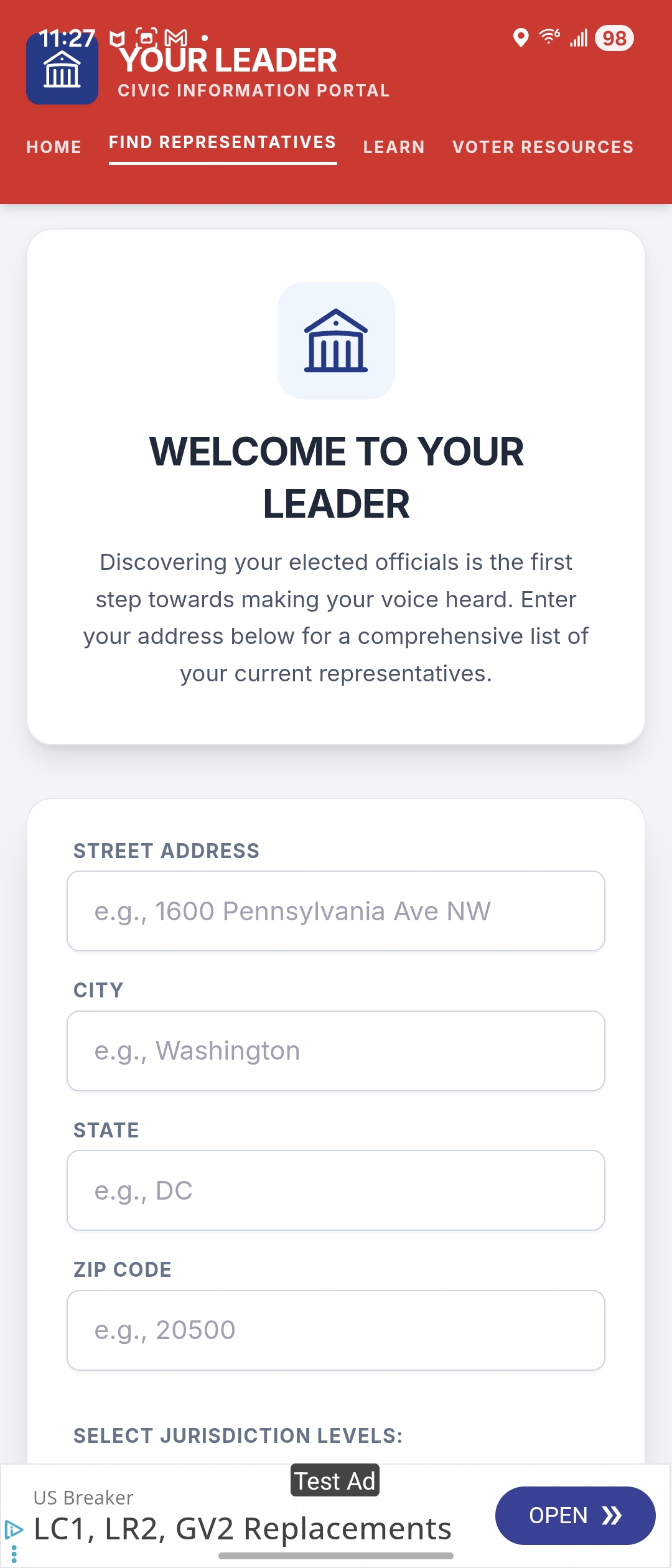
Your Leader collapses that distance: enter where you live, see everyone who represents you, at every level, with what they do and how to contact them.
A civic app has a brutal economic shape: useful to everyone, monetizable to almost no one. Every design decision had to respect that — which produced the app's defining engineering choice.
Federal representatives are a small, slowly changing dataset. Instead of paying an API on every lookup, federal data ships inside the app — instant, offline-capable, and free at any scale. API spend is reserved for what genuinely varies.
Civic questions punish hallucination — a wrong "who represents me" is worse than no answer. The AI layer uses Gemini with Google Search grounding, so responses cite what's current instead of what the model half-remembers.
No editorializing, no scoring, no partisanship in the interface — the app's job is to make the civic map legible, and trust depends on it staying a map.
Your Leader is in the portfolio because of what it demonstrates: that economic constraints can drive architecture the same way user needs drive interfaces. The hardcoded-federal-data decision, the grounding requirement, the neutral presentation — each is a response to a hard limit, and the product is better for all three.
It also completed a UX case study of its own — one of the self-contained portfolio pieces built for my design job applications, alongside ADIN.
 Ceymer Studios